

Find Us
Address
3480 Clayton Road
Concord, CA 94519Hours
Tuesday–Saturday:
10:00AM–5:00PM
Sunday & Monday:
CLOSED
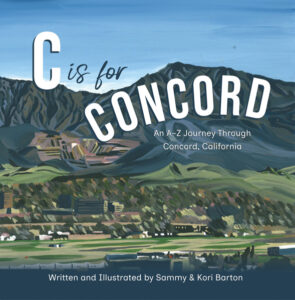
C is For Concord: An A-Z Journey Through Concord, California. Written and illustrated by Sammy and Kori Barton. $16.00 paperback.
This charming book presents a glimpse of Concord’s history and attractions. It’s a slim book, but don’t be fooled – it’s somehow bigger on the inside, packed with stories about our city, from mini-histories of Mount Diablo, Buchanan Airfield and the Cowell Portland Cement Company to purely local interest stories about the family-owned King’s Donuts, the (now) West Wind Drive-In, and the Christmas lights extravaganza Bruce Mertz set up for many years at his home on Olive Drive. There’s a nice balance between the past and present: it’s good that we should know about Ignacio Sibrian and Salvio Pacheco – but it’s also fun to see modern-day notable Tom Hanks included!
The book gives a fine sense of the evolution of familiar places over time. The Iron Horse Trail’s railroad days are gone, but the trail is now a popular community hiking and bicycle trail. And the former Concord Naval Weapons Station, important during World War II, became a “ghost town” after it was decommissioned, then a refuge for a herd of Tule elk successfully brought back from near-extinction, and the bunker section will one day be an open-space park.
Each “letter” is illustrated with a colorful painting by Kori Barton, a sprightly rhyme, and the fuller story in a sidebar, making it perfect for a family read-along.
The Bartons are almost finished with a new book, W is for Walnut Creek, which will be out soon. We’re looking forward to it! We’ll certainly carry it at the shop along with C is for Concord.
You can find out more about the authors in an interview in The Pioneer
–Cheryl
Secret Santa Cruz: Tees of Mystery
Or T-Shirt History, NOT the History of T-Shirts
Or …
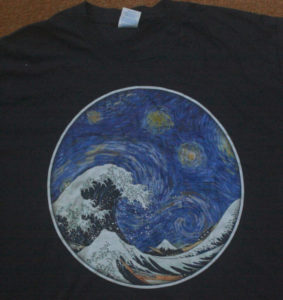
Now that we have our website up again (finally) it seems like the right time to recommend some things (usually it’ll be books) for our followers to enjoy. In this case, I want to enthusiastically recommend an unusual website/blog run by a friend of mine. Jim (his full name is Jim Jones, but not that Jim Jones) has always had some unusual interests, although we originally met and became friends because of a mutual enjoyment of science fiction and pulp fiction, especially the good old stuff. I’m talking about the real old-time pulp fiction published in the early to mid-20th century. We both collected the old magazines, the cheesy paperback books, and when we could afford them, rare collectible hardcovers.
Jim and I moved on from that time, me ultimately to a career in bookselling, my friend Jim to the early expanding tech industry and later with the University of California at Santa Cruz. We’re both older now and one of us is retired. Jim has published a number of books of his own writings, some of which I’ll be featuring later on. But Jim’s blog features one of his current interests that I want to promote. His website devoted to t-shirt culture – Tees of Mystery – is a remarkably informative (I might even say “educational”) and fun examination of a much overlooked sociological phenomenon – the American graphic t-shirt. We’re all familiar with t-shirts that promote products, events, rock shows, social groups, sports, etc., but Jim is the first person I know who has gone to the trouble of examining the origins of some of these as well as many t-shirts devoted to more arcane interests, such as biker groups, petrochemical colonial outposts in the 3rd world, drug and alternative (some might say “hippie” or “surf”) culture, and a lot more. One of his recent postings analyzed various promotional t-shirts produced by bookshops. Our shop’s 15th anniversary t-shirt is among those featured, I *ahem* mention modestly.
Jim’s t-shirt interest started, as these things often do, as a form of collecting. Here were all these really strange t-shirts available for sale for a buck or two at the local thrift shops, sometimes devoted to organizations or events Jim had never heard of before. Over time, the t-shirts accumulated. And accumulated. Hundreds (thousands?) of t-shirts later, Jim realized that many of the t-shirts were related by certain interests or themes. There was actual history here, and thanks to the relatively new data repository called “the Internet”, Jim could do research into the obscure (or sometimes the once famous but now forgotten) causes or events these t-shirts commemorated. Jim’s collecting hobby has morphed into a most unusual, and in my opinion fascinating cultural/historical project.
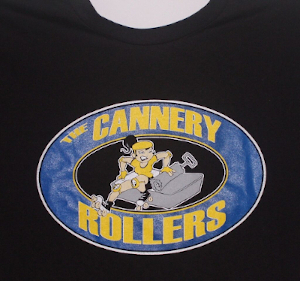
From “Roller Derby Tees, and Dreams of Joan Weston,” a celebration of California blue-collar culture at the intersection of John Steinbeck and Roller Derby
Tees of Mystery is an easily navigated and enjoyable blog with many categories of t-shirt featured. A partial listing of the t-shirt categories follows:
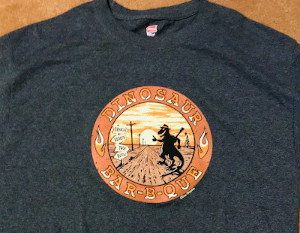
So, if you’re tired of the same-old-same-old Instagram/Twitter/TikTok web-stuff and want to do some interesting reading into little-discussed American sub-culture (as expressed in t-shirt graphics), check out Jim’s site: Tees of Mystery.
For those of you interested in our bookshop’s 15th anniversary t-shirt: Independent Bookies.
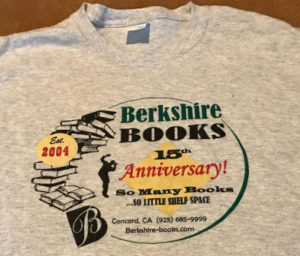
We still have a few left, btw. And tote bags with the same design! (shameless plug)
–LK
Our website is back! Sort of.
Last month, our IP, a small company we’ve been with for years, suffered a catastrophic failure. As in, everything is gone. Backups didn’t backup, cloud backup disappeared, as one fail-safe after another bit the dust. So to speak.
So, we moved. Some people could have done this quickly, effortlessly and without losing hair yanked out from the roots, but we are not those people. But finally, here we are.
Starting all over from scratch. Which is probably a good thing. The old blog was getting, shall we say, dated? Cobwebby? Snooze-inducing? All of the above.
I’m not sure what-all is going to happen here. But two bits of information are in order:
The Crossings Book Club is on hiatus due to the pandemic, obviously.
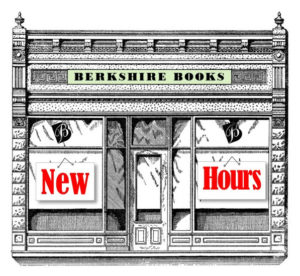
Berkshire Books, while open, is operating on a reduced schedule.
Tuesday through Saturday, 10:00 a.m. to 3:00 p.m.
Sunday and Monday: CLOSED